
Eric Boué-Grabot and al in Nature Communications
Light, a non-invasive alternative to painkillers
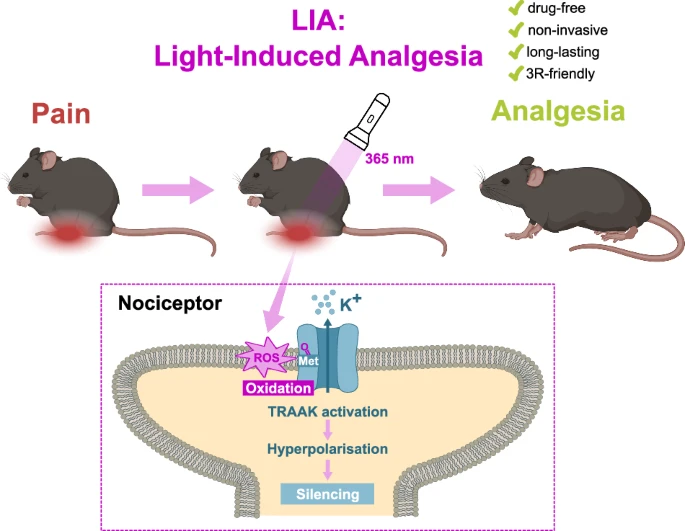
Turning on the light to turn off the pain: this is the principle behind a new pain relief method called LIA (Light-Induced Analgesia), discovered by scientists at the CNRS in rodents. Non-invasive, LIA is more effective and longer lasting than painkillers such as ibuprofen. The article was published in the journal Nature Communications on January 26, 2026.
LIA is based on the direct inhibition of pain receptors. In rodents, a protein called TRAAK, whose function is to slow down pain transmission, is activated by illumination centered at 380 nm (close to violet), which can be produced by a simple lamp. A few minutes of exposure, without injection or stress for the animal, is enough to relieve pain, even in models of chronic pain. By targeting only pain receptors, this non-drug approach avoids the side effects of traditional drugs, which act on the entire body. Particularly applicable to exotic pets such as chinchillas, hamsters, and even more exotic species such as Hermann’s tortoises and boas, LIA offers a simple, effective, and inexpensive treatment for pain in veterinary clinics.
However, this sensitivity to light in rodents is not shared by humans: a single difference in the TRAAK protein sequence is enough to render LIA ineffective in humans. Nevertheless, the study identifies TRAAK as a promising new therapeutic target and paves the way for the development of new, non-light-based strategies to activate this channel and relieve pain in an effective and targeted manner in human clinical settings.
For more
Light-induced analgesia provides a drug-free optical method for pain relief via activation of TRAAK k+ channels
Marion Bied, Arnaud Landra-Will, Anne Amandine Chassot, Edward Francisco Mendez-Otalvaro, Benjamin Sueur, Kilian Roßmann, Elvira de la Peña Garcia, Pascal Fossat, Stephen J Tucker, Jacques Noël, Wojciech Kopec, Felix Viana, Johannes Broichhagen, Eric Boué-Grabot, Guillaume Sandoz
Nature Communications, January 26th, 2026
Contact
Eric Boué-Grabot
CNRS Research Director
Team Leader
Purinergic mediated neuroinflammation and brain disorders
Last update 27/01/26