
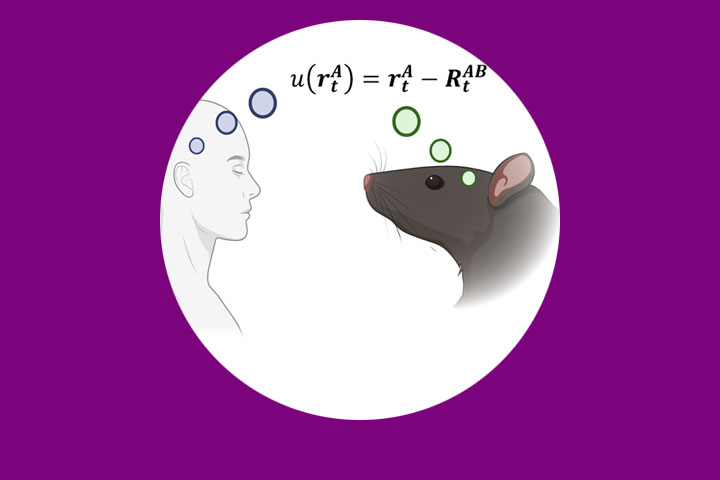
Humans and Rats: The Same Cognitive Biases When Evaluating Rewards
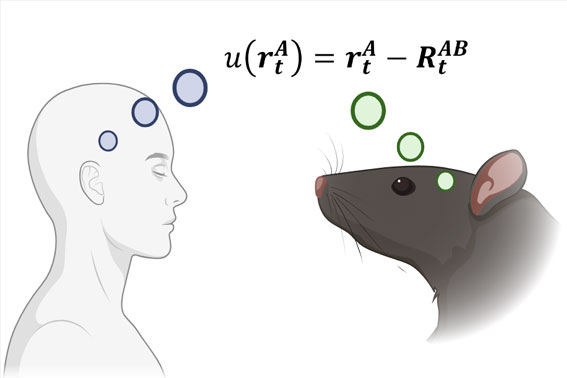
Imagine choosing between two dishes at a restaurant: one seemed excellent during a mediocre meal, while the other was disappointing during an outstanding dining experience. Even if both dishes are objectively of similar quality, people tend to prefer the first, because it was the best option within its original context. This tendency reflects a well-known cognitive bias in which the value of an experience is encoded relative to the environment in which it was learned, rather than in absolute terms.
A recent study published in Nature Communications led by Shauna Parkes (INCIA, DR CNRS) and Lachlan Ferguson (former INCIA postdoctoral researcher, now at UNSW Sydney), in collaboration with Stefano Palminteri (ENS Paris, DR INSERM), Magdalena Soukupova (ENS Paris), and Sébastien Bouret (ICM Paris, DR CNRS), investigated whether this “relative value” bias is unique to humans or shared across species.
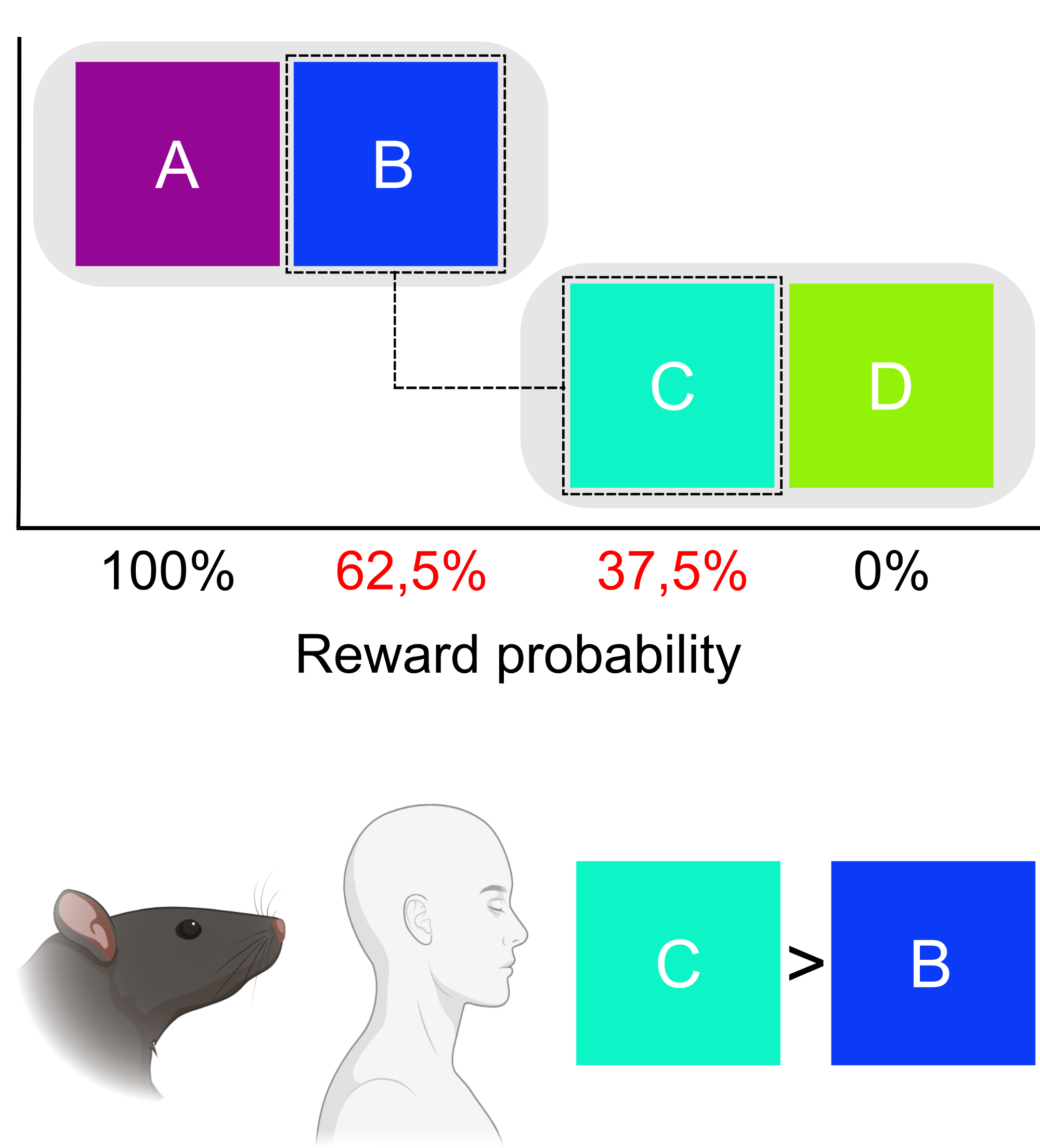
Using closely matched reinforcement-learning tasks in humans and rats, participants learned through trial and error which options were more likely to be rewarded (monetary rewards for humans and food rewards for rats). The options were presented in “rich” and “poor” contexts with different reward rates, before being recombined in a final test where objective reward probabilities were equivalent.
The results show a strong convergence between species: both humans and rats consistently overvalue options that were the best within their original context, even when they are objectively no better than alternatives. This bias also leads to suboptimal choices when context-based preferences conflict with actual reward rates.
Computational modelling further revealed that the same underlying learning mechanism could explain behaviour in both species. A reference-based learning model, in which outcomes are evaluated relative to the average reward in each context, best accounted for the observed choices. While this normalization strategy improves efficiency in processing variable environments, it also produces systematic distortions in value-based decision-making.
These findings suggest that relative value encoding is an evolutionarily conserved feature of decision-making, shared across humans and rodents, and not a uniquely human cognitive bias. More broadly, this work provides a translational framework for studying how context influences learning and decision-making, with important implications for conditions such as addiction, where these processes may be disrupted.
Reference
Reference-point dependent reinforcement learning in humans and rats.
Lachlan A. Ferguson*, Magdalena Soukupova*, Sébastien Bouret, Stefano Palminteri# & Shauna L. Parkes#.
Nature Communications
https://doi.org/10.1038/s41467-026-73623-x
*These authors contributed equally
#These authors jointly supervised this work
Contact
Shauna Parkes
Directrice de recherche CNRS (INCIA)
Last update 16/06/26