
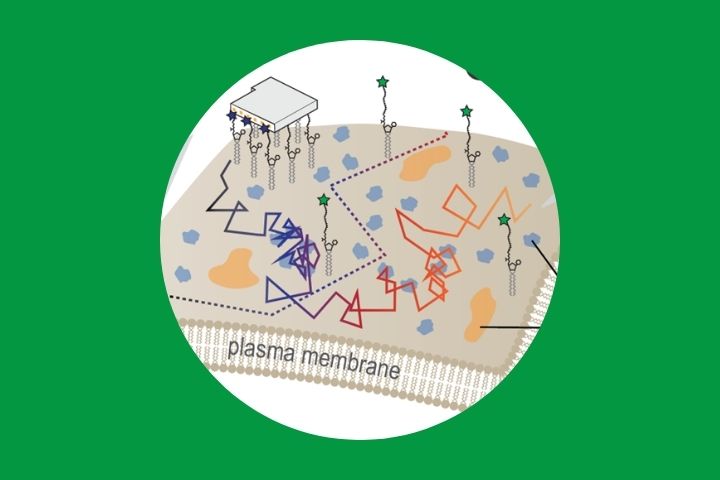
Corradi et al. in Nano Letters
Plasma membrane (PM) lipids and proteins partition into nanodomains that regulate essential cellular processes, including signaling, trafficking, and responses to mechanical forces. However, their small size and dynamic nature make them challenging to study in living cells.
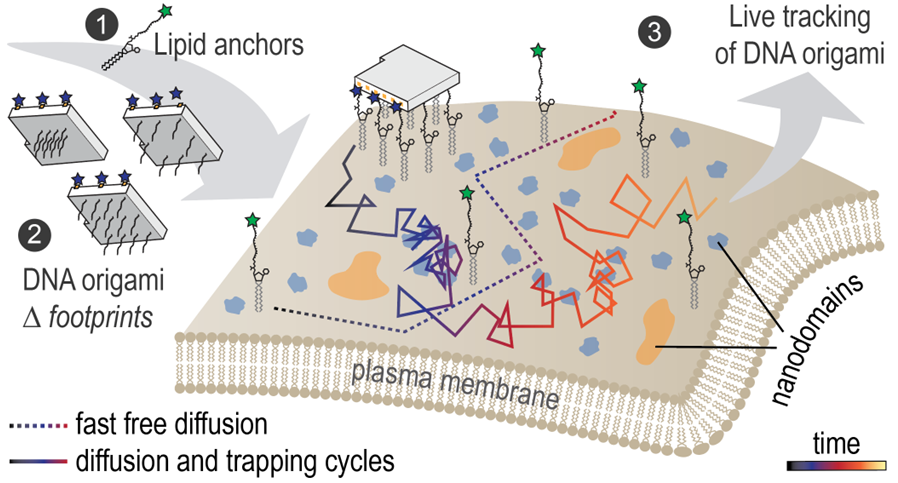
In a recent article published in Nano Letters, which also featured their work on the cover, Eloina Corradi, a postdoctoral fellow working with Grégory Giannone at the Interdisciplinary Institute for Neuroscience (IINS), showed that the diffusion of DNA origami-based probes inserted into the plasma membrane via lipid anchors can reveal nanoscale features of PM organization in living cells.
DNA origami enables the folding of a long single-stranded DNA scaffold into a user-defined structure with single-base precision, resulting in a nanoparticle that can be sculpted with single-nanometer resolution. This allows precise control over lipid anchor number and spatial arrangement, enabling nanometer-scale sampling of the PM.
Once inserted, probes diffusing across the membrane are followed by single-particle tracking to survey the PM landscape. Varying lipid anchor number and arrangement shows that origami immobilization requires simultaneous interactions with multiple, densely packed PM nanodomains smaller than 20 nm. Disrupting the actin cytoskeleton reduces immobilization, confirming its role in nanodomain stability. Moreover, acute cell stretching transiently increases origami mobility, indicating that mechanical forces can reversibly regulate PM nanodomain organization.
The DNA origami were designed and built with the group of Shawn Douglas (University of California, San Francisco, USA), and the lipid anchors were developed with Arnaud Gissot (ARNA U1212/CNRS 5320, University of Bordeaux). This tool provides a powerful strategy for mapping membrane architecture at the nanoscale, offering insights into how cells dynamically regulate PM nanodomain organization in response to biochemical and mechanical signals.
For more information
Using DNA origami to study nanoscale organization of plasma membranes, Eloina Corradi†,*, Konlin Shen†, Zeynep Karatas, Maureen Cercy, Thomas Schlichthaerle, Margaux Caumont, Mélissande Osouf, Brune Vialet, Philippe Barthelemy, Morgane Rosendale, Adiyodi Veetil Radhakrishnan, Tianchi Chen, Ralf Jungmann, Arnaud Gissot, Shawn M. Douglas‡, Grégory Giannone‡,*.
† These authors contributed equally to this work (co–first authors).
‡ These authors jointly supervised this work (co–senior authors).
* Corresponding authors
DOI: 10.1021/acs.nanolett.6c00255
Nano Letters, April 20th, 2026.
Contacts
Eloina Corradi
Postdoctoral researcher
Team Spatio-temporal and mechanical control of motile structures
Grégory Giannone
CNRS Researcher – Team leader
Team Spatio-temporal and mechanical control of motile structures
Last update 03/07/26