
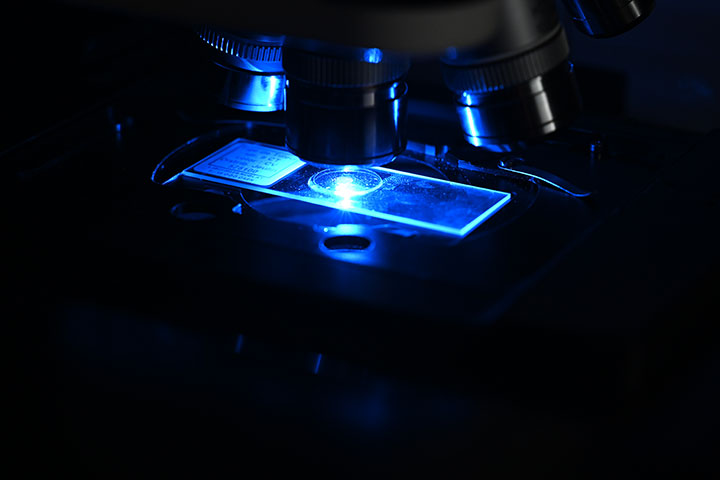
Boosting Biological Imaging in Bordeaux
The Nouvelle-Aquitaine Region and the European Union, through the European Regional Development Fund (FEDER, for “Fonds Européen de Développement Régional”), are supporting two flagship projects led by the Interdisciplinary Institute of Neurosciences (IINS) and the Bordeaux Imaging Center (BIC). With nearly €3 million in FEDER funding — in addition to investments already secured under France 2030 and the State-Region Planning Contract (CPER, for “Contrat de Plan État-Région”) — a total of nearly €5 million will be invested in imaging infrastructure for the Bordeaux scientific community. This exceptional effort will further strengthen one of Europe’s leading centers in the field of life science imaging.
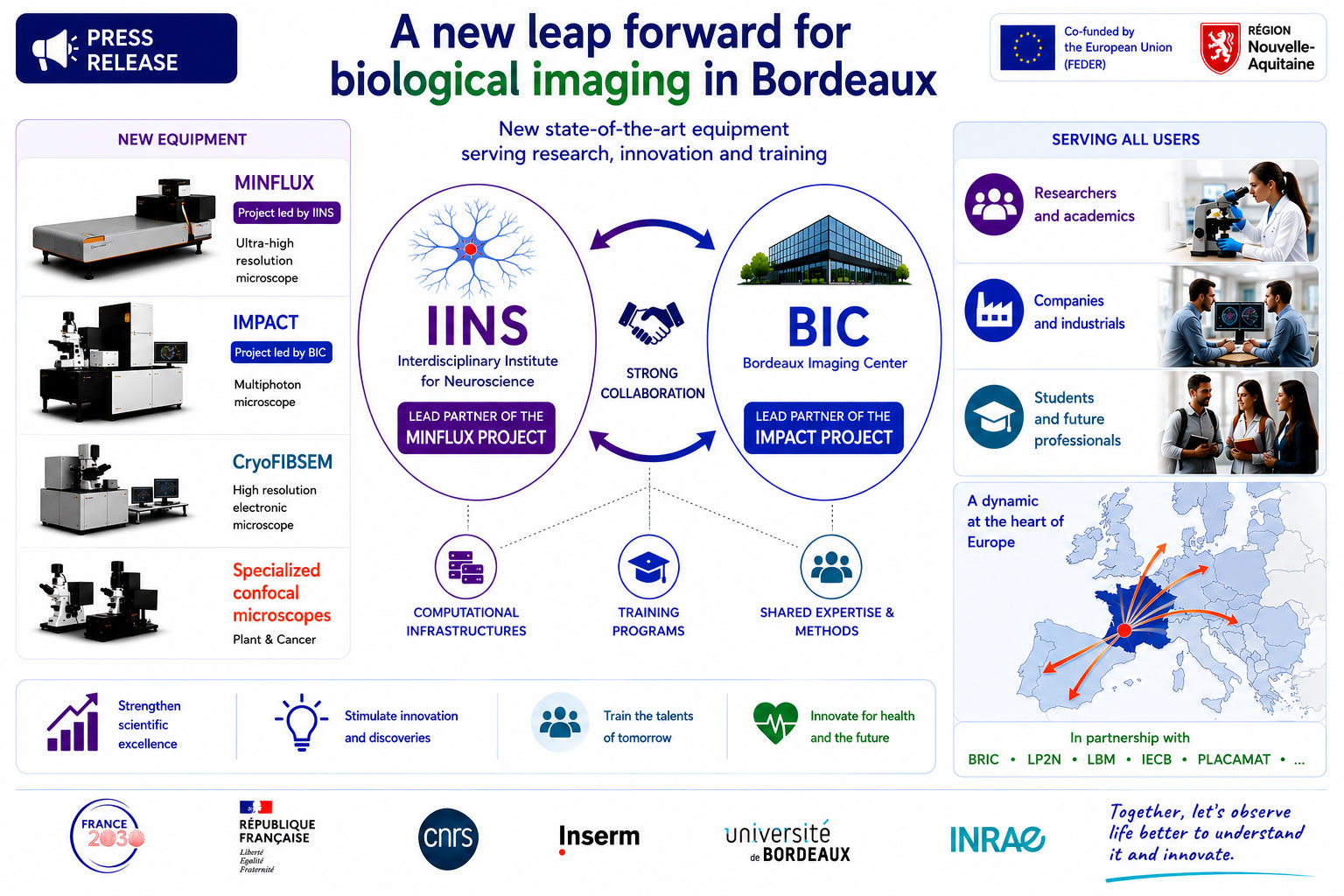
Bordeaux is internationally recognized for its expertise in advanced biological imaging. The teams at the Interdisciplinary Institute of Neurosciences[1] and the Bordeaux Imaging Center[2], two units of Bordeaux Neurocampus, are among the leading players in the development and use of cutting-edge imaging technologies for the study of living organisms. The BIC is also a founding member of France BioImaging and Euro-BioImaging, the leading national and European infrastructures in biological imaging, which bring together and coordinate the major platforms in the field.
This momentum has recently been further strengthened by the selection of two major projects under the Nouvelle-Aquitaine FEDER programme[3]: MINFLUX and IMPACT. The CNRS is responsible for the administrative management of these projects.
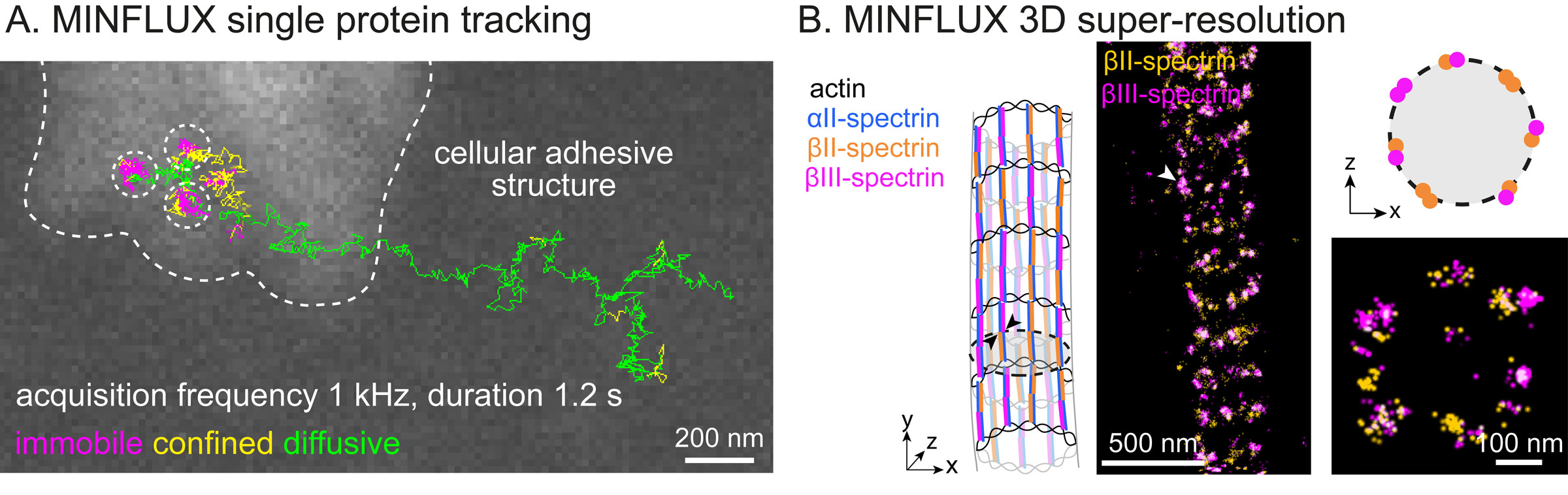
The MINFLUX project, led by IINS, will enable the acquisition of the first MINFLUX microscope to be installed in France and south-west Europe. The MINFLUX system represents a major technological breakthrough in photonic imaging and will be installed at the BIC. Developed from the work of Stefan Hell, winner of the 2014 Nobel Prize in Chemistry, this revolutionary technology achieves a localisation accuracy of 1 to 2 nanometres and enables the tracking of individual proteins at over 1,000 locations per second, bridging the gap between optical microscopy and structural biology. For the first time, it enables the direct observation of individual proteins with sufficient precision and speed to resolve their conformational changes, dynamic interactions and molecular architecture, capabilities unattainable by any other optical approach. Thanks to this unique equipment, Bordeaux, with the support of the Nouvelle-Aquitaine Region, will become a reference centre for this technology at both national and European level.
The IMPACT project, meanwhile, will equip the BIC with a new generation of multiphoton imaging tools, enabling the observation of molecular interactions within thick living tissue with unprecedented precision and depth of analysis. This infrastructure will open up new opportunities in fields as diverse as neuroscience, cell biology, microbiology, plant biology, oncology and health biotechnology.
These investments also include the deployment of new high-performance computing and storage infrastructure, which is essential for processing, analysing and utilising the massive volumes of data generated by these next-generation imaging technologies.
This new equipment complements the investments already committed under France 2030, the State-Region Planning Contract and several major national and European programmes. In total, nearly €5 million will be allocated to strengthening the optical and electronic imaging capabilities of the local scientific community.
Beyond their scientific impact, these investments will have a major positive effect on the entire regional ecosystem. They will help to make Nouvelle-Aquitaine more attractive to researchers, students and innovative businesses, strengthen collaborations with industry partners, and develop new training programmes in cutting-edge technologies.
The ambition is to offer the academic and industrial community one of the most advanced technological environments in Europe, capable of observing biological phenomena at all scales, from the living organism down to the individual molecule.
Thanks to these investments, Bordeaux is consolidating its position amongst the major international centres for life imaging and equipping itself to accelerate the scientific discoveries and innovations of tomorrow.
[1] IINS (CNRS/Université de Bordeaux)
[2] BIC (CNRS/Inserm/Université de Bordeaux)
[3] Le FEDER (Fonds Européen de Développement Régional) est un outil de la politique de cohésion européenne qui vise à réduire les écarts entre les régions européennes.
Contacts
Bordeaux Imaging Center (BIC)
Daniel Choquet, directeur du BIC et coordinateur du projet IMPACT –
Christel Poujol, responsable du pôle photonique du BIC et co-coordinatrice du projet IMPACT –
Institut Interdisciplinaire de Neurosciences (IINS)
Grégory Giannone, responsable d’équipe à l’IINS et coordinateur du projet MINFLUX –
Anna Brachet et Olivier Rossier, Chercheurs à l’IINS et co-coordinateurs du projet MINFLUX – ,
Last update 11/06/26