
Alessandro Piccin et al. in Cell Reports
 Noradrenaline helps the brain switch behavioral strategies
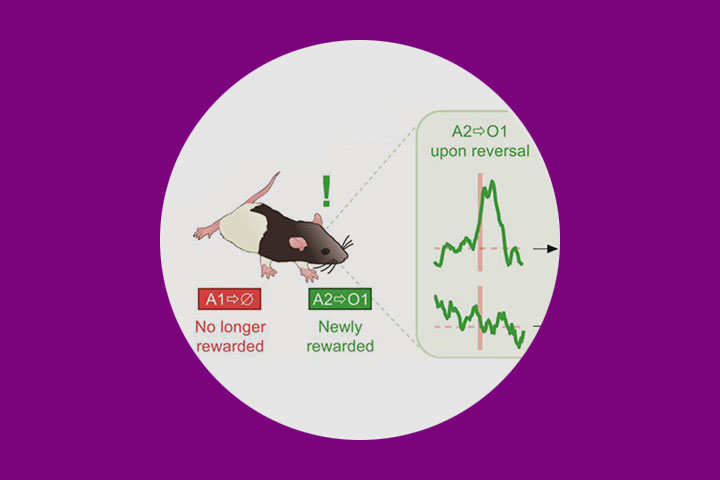
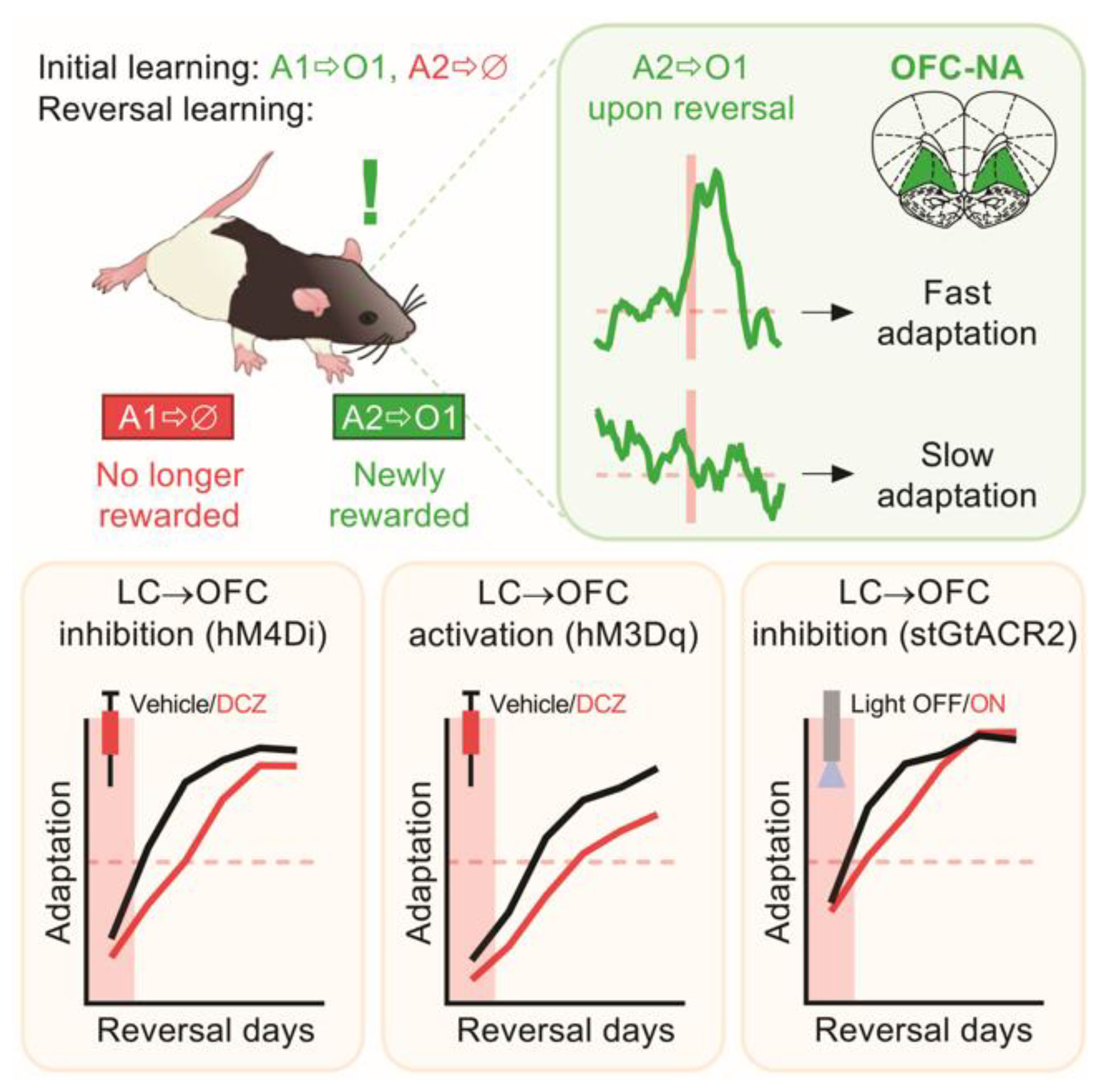
Adapting behavior when the rules change is essential for coping with uncertainty. Researchers at INCIA show that brief bursts of noradrenaline in the orbitofrontal cortex, triggered by unexpected rewards, promote behavioral updating during reversal learning.
Using a rat model, the team combined fiber photometry with circuit-specific chemogenetic and optogenetic approaches to monitor and manipulate noradrenergic signaling from the locus coeruleus (LC) to the orbitofrontal cortex (OFC). They found that the magnitude of this signal predicts how rapidly animals adjust to a new rule, and that disrupting the LC→OFC pathway delays adaptation after a contingency shift.
Published in Cell Reports, these findings support a central role for the locus coeruleus in behavioral flexibility and underscore the selective influence of noradrenergic input on prefrontal cortical function. The study further identifies orbitofrontal noradrenaline as a temporally precise early gate that enables the brain to update action–outcome associations when environmental contingencies change.
This study received support from two ANR projects (CE37-0019 NORAD and CE14-0020 FRONTOFAT), as well as a Young Investigator Grant from the Brain & Behavior Research Foundation awarded to the first author, Alessandro Piccin, now an MSCA postdoctoral researcher at the University of Cagliari, Italy.
For more information
Alessandro Piccin, Hadrien Plat, Yacine Tensaouti, Matthieu Wolff, Alain R. Marchand, Etienne Coutureau.
Orbitofrontal noradrenaline acts as an early gate for reversal learning.
Cell Reports, Volume 45, Issue 3, 2026, 117105, ISSN 2211-1247,
DOI: 10.1016/j.celrep.2026.117105.
Contact
Etienne Coutureau
Directeur de recherche CNRS (INCIA)
+33 5 57 57 15 48
Last update 29/04/26