
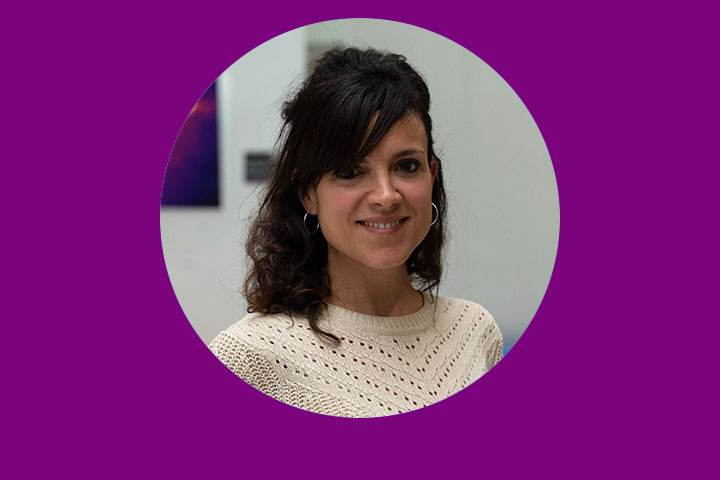
Women’s Voices: Maria-Carmen Medrano
This month in Women’s Voices, Sara Carracedo interviewed Maria-Carmen Medrano, a neuroscientist from Cabreton (La Rioja, Spain) whose career spans several countries and research fields. She has recently been appointed Lecturer in animal and human physiology at the University of Bordeaux. In this interview, she reflects on her scientific path and shares insights into the demands of parenting alongside a scientific career.
Sara Carracedo: Could you tell us about your path in neuroscience?
 Maria Carmen Medrano: I have a PhD in Pharmacology and I’ve built an international postdoctoral career in neuroscience, working in top academic labs across Spain, France, the UK, and Canada. My research looks at how addiction and chronic pain affect the brain, especially in relation to attention and cognition. I use a mix of techniques (electrophysiology, pharmacology, and behavioral analysis) to explore the brain circuits involved, from the spinal cord all the way up to regions like the cingulate cortex, the locus coeruleus, and the ventral tegmental area.
Along the way, I’ve also been teaching and mentoring students at both the undergraduate and Masters level, which has been a big part of my journey. Since November 2023, I’ve been working with the “Motor control and cognition” (MOCOCO) team at INCIA at the Bordeaux Neurocampus. My current project examines how noradrenaline modulates the corticospinal circuit, with a focus on sensory-motor integration and its clinical applications.
And most recently, something I’m very excited about, I’ve been appointed Maîtresse de Conférences (Lecturer) in animal and human physiology, starting this September (2025). It’s a big milestone for me and something I’ve been working toward over the last ten years of research and teaching.
What is your current research about at INCIA?
At INCIA, I’m developing a translational and integrative research project focused on the neurophysiology of sensorimotor integration, in both physiological and pathological conditions, with a particular emphasis on the role of noradrenergic modulation. By investigating how pain and movement interact, from the spinal cord to the cortex and including autonomic regulation, I aim to better understand the complex relationships between nociception, motor control, and higher brain functions. Acute pain plays a crucial protective role, guiding motor adjustments to avoid injury. But when pain becomes chronic, it can disrupt motor function, leading to loss of strength, coordination, and mobility. My project seeks to explore these reciprocal interactions in depth and to identify how they’re modulated by noradrenergic circuits, which could help guide more integrated therapeutic approaches. To study these mechanisms, I combine electrophysiological recordings in rodents, transcranial magnetic stimulation (TMS) in humans, and pupillometry in both species as a non-invasive readout of noradrenergic neuromodulation.
As a mother, how have you dealt with the demands of parenting alongside a scientific career? Do you feel that family responsibilities have affected your visibility or opportunities in research?
I became a mother at the end of my third postdoc project. My contract finished right when my son was born, and at the same time, my partner was doing his PhD. We’re both foreigners, and without family nearby to help, we had to face the first months of parenthood on our own. I felt very supported by my team and supervisor, and I made the conscious choice to take a break from research, simply because I wanted to. It was the right decision for me and, as it happened, COVID arrived at the same time, which in some ways reinforced that choice.
Coming back wasn’t easy. I’ve managed to find new postdoc opportunities, to continue publishing, and to keep growing as a researcher. But managing work and parenting, with no external help, while both of us were in precarious academic positions, was incredibly demanding. The uncertainty of the job market becomes especially heavy when you have someone else depending on you. Still, I’ve been lucky to have a very supportive partner, going through similar struggles as me, and that we deeply understand one another’s pressures and needs.
Opportunities sometimes come later, and others are simply gone. But I’ve learned to stay focused and confident, and to keep going while also embracing family life and everything it brings. It’s not easy, but it has taught me resilience, clarity, and renewed motivation.
What structural support (or lack thereof) have you encountered regarding childcare or parental leave in academia? How do you think institutions could evolve to better support early-career scientists with families?
Childcare support for early-career researchers is unfortunately very scarce and expensive, especially during the first years when the child’s needs are greatest. Considering the modest salaries and precarious conditions of PhD students and postdocs, affordable and flexible childcare options are simply out of reach for many. On top of that, practical challenges like school holidays or days off (for example, Wednesdays without school in France) make it impossible to work a regular full week without interruptions or extra childcare solutions.
While universities and research organizations offer some childcare facilities, they are mostly designed for permanent staff. There is very little specifically tailored to postdocs or PhD students, who arguably need this support the most, given their unstable contracts and uncertain futures. This gap creates a real barrier for early-career scientists trying to balance family and research.
Institutions could evolve by developing more inclusive and flexible childcare programs, accessible regardless of contract status. Subsidies or partnerships with local childcare providers to make services affordable would be a huge help. Specific support for foreign researchers, who often lack family nearby, is also essential. More flexible working hours or remote work options, especially during school holidays, could also ease the pressure.
Ultimately, creating an environment where early-career scientists with families feel supported would not only improve well-being but also promote equality and retention of talented researchers in academia.
Sara Carracedo: What advice would you give to early-career researchers who are considering starting a family?
Maria Carmen: My advice would be: if that’s what you want, go for it! Having a family and pursuing a scientific career can definitely be challenging, but it’s also deeply rewarding and absolutely possible. The key is to plan ahead as much as you can. From the very beginning of your pregnancy, start thinking about childcare options: look into what’s available, talk to other researchers or friends who have gone through it, and don’t hesitate to ask for advice and support.
Building a good support network is crucial, whether it’s your partner, colleagues, or friends, because balancing family and research is easier when you’re not alone. Also, be kind to yourself: there will be times when things feel overwhelming or delayed, and that’s normal. It’s important to stay flexible and patient and remember that your career path might look different from others, and that’s okay.
Finally, keep communicating openly with your supervisors or teams about your needs and challenges. Many people are more understanding than you might expect, and having that dialogue can help create a better environment for you and others who follow.
About Women’s Voices
Women’s Voices is an interview published in Brainstorm and on Neurocampus’ website created in partnership with the Neurocampus Parity and Inclusion Committee (NeuroPIC) a local group committed to promoting equality and organizing actions to close the gap between women and men in academia. The goal of this section is to increase the visibility of early career female researchers at the Bordeaux Neurocampus of the University of Bordeaux. We interview researchers about their scientific contributions, insights and opinions about equity, diversity and gender bias in academia. Through these interviews, we aim not only to highlight their achievements but also to serve as inspiration for our scientific community and other female scientists.
Last update 19/12/25