
Understanding how our emotions influence decision-making through the dorsomedial prefrontal cortex
The dorsomedial prefrontal cortex plays a major role in decision-making. For the first time, the research team of Cyriil Herry (Neurocentre Magendie – Inserm / University of Bordeaux), in collaboration with Swiss researchers, has succeeded in precisely mapping its activity to show how neurons in this brain region simultaneously encode the valence (positive or negative), value (more or less important), and salience (more or less likely to capture attention) of stimuli that elicit different emotions — strong enough to motivate specific behaviors in mice. Their findings were published in the journal Nature on January 7th, 2026.
Decision-making is a complex process that relies on a vast neural network. A negative experience can lead to avoidance behaviors, while a positive experience can encourage us to repeat actions associated with a form of reward. But how does the brain transform information from our environment into motivations that guide our choices?
This is precisely the question explored by the research team of Cyril Herry (Neurocentre Magendie), which closely examined the activity of a key brain region involved in emotional and decision-making processes: the dorsomedial prefrontal cortex.
“Much like an orchestra conductor, the dorsomedial prefrontal cortex integrates signals from multiple brain regions with positive or negative emotional significance and orchestrates neural network activity to generate behavior adapted to each situation. However, how it processes and organizes this information remains poorly understood,” explains Daniel Jercog, a researcher now based at the University of Copenhagen and senior author of the study.
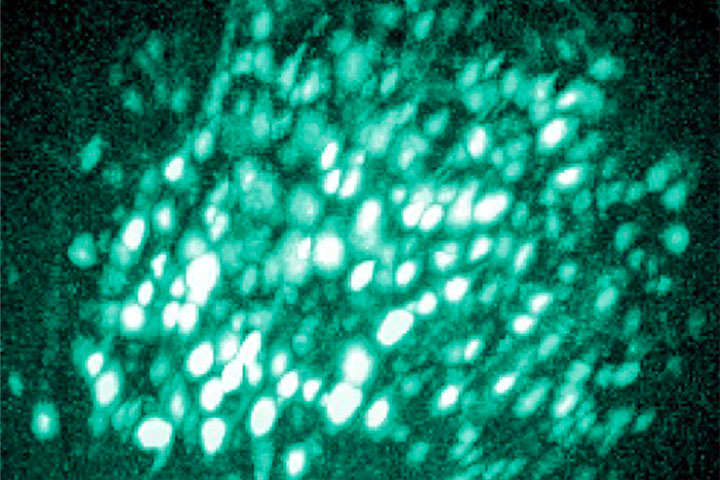
To gain clearer insight, the scientists recorded activity in the dorsomedial prefrontal cortex of mice using cellular-resolution calcium imaging—a technique that allows real-time visualization of neuronal activity during behavior by detecting changes in calcium concentration, a key indicator of neuronal excitation.
In the experiment, mice learned to recognize different sound cues. Depending on the cue, the mice had to adopt an appropriate behavior: approaching the sound source when it predicted a reward, avoiding the area when the sound was associated with an unpleasant stimulus, or doing nothing when the sound had no particular consequence.
The researchers observed that neurons in the dorsomedial prefrontal cortex primarily encoded the emotional value of stimuli generated by the environment, and that these emotional value representations engaged distinct prefrontal neuronal populations. At the same time, they found a simultaneous encoding of valence (positive or negative) and salience (degree of importance or intensity) along orthogonal axes—that is, independent from one another. “This neuronal organization continuously evolves depending on the nature of the stimuli, allowing great flexibility and rapid behavioral adaptation to context,” explains Nanci Winke, first author of the study.
“This is the first study to show how neurons in the dorsomedial prefrontal cortex simultaneously encode valence, value, and salience of environmental stimuli,” emphasizes Cyril Herry, Inserm Research Director and co-author of the study. “However, our results do not allow us to conclude that the same mechanisms exist in humans, whose brain function differs substantially from that of mice. This is precisely what our future research aims to clarify.”
In the long term, the scientists hope their discovery will contribute to improved treatment of psychiatric disorders that disrupt brain function during emotionally charged decision-making, whether positive or negative. “We hope that our findings will help develop new approaches to better understand and treat mental illnesses such as anxiety and depression, which can alter our emotional responses to information from our environment,” concludes Cyril Herry.
Reference
Prefrontal neural geometry of associated cues guides learned motivated behaviors
Nature, 7 janvier 2026
Nanci Winke1,2, Andreas Lüthi2,3, Cyril Herry1,*, Daniel Jercog1,4*
1 Univ. Bordeaux, INSERM, Neurocentre Magendie, U1215, F-33000 Bordeaux, France
2 Friedrich Miescher Institute for Biomedical Research; Fabrikstrasse 24, CH-4058 Basel, Switzerland.
3 University of Basel, CH-4000 Basel, Switzerland.
4 Department of Neuroscience, University of Copenhagen; Blegdamsvej 3, Copenhagen, 2200, Denmark
* Corresponding authors
DOI : https://doi.org/10.1038/s41586-025-09902-2
Contacts
Last update 13/01/26