
Marneffe et al. in Current Biology
There is a strong agreement that memories are stored by means of activity-dependent changes in the strength of synapses – a process called synaptic plasticity. A very large majority of studies linking synaptic plasticity and memory relate to long term changes in post-synaptic parameters.
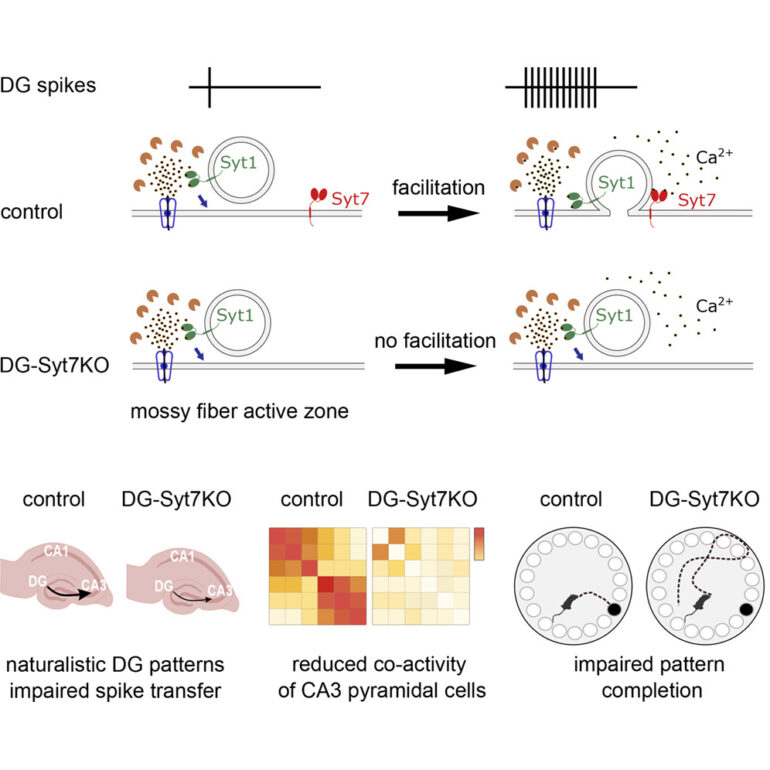
In a recent article published in Current Biology, Catherine Marneffe – a former PhD student under the supervision of Christophe Mulle at the Interdisciplinary Institute of Neuroscience (IINS) – has explored the circuit and behavioural consequences of removing presynaptic short plasticity at an identified hippocampal synapse.
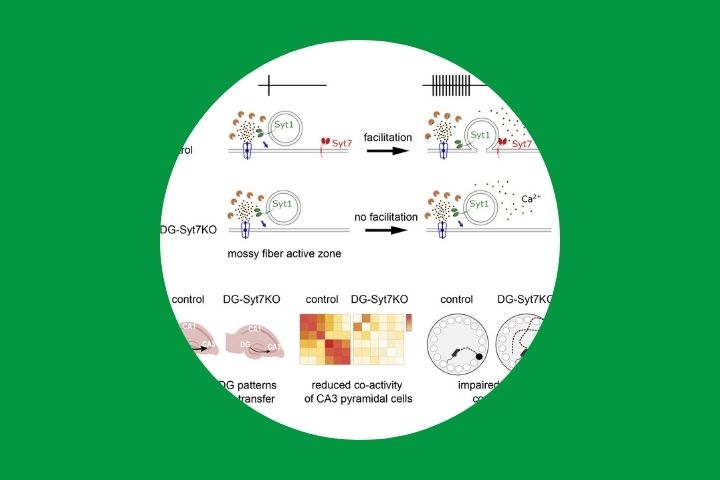
Hippocampal mossy fiber synapses, which connect the dentate gyrus to the CA3 region, are dubbed “detonator” synapses due to their remarkable level of presynaptic short-term facilitation. These properties have long been thought to play a role in memory acquisition based on computational analyses, albeit with no experimental demonstration of these hypotheses. Here, Marneffe et al. have selectively suppressed the calcium sensor Synaptotagmin 7 in presynaptic mossy fibers in mice, leading to a precise abrogation of presynaptic short-term plasticity. This impacts the activity of CA3 circuits in vivo, by impairing the co-activity of ensembles of CA3 pyramidal cells. In turn, these mice show deficits in spatial memory tasks that rely on the process of pattern completion, but not on pattern separation.
These results give important insights into how the remarkable detonator properties of DG-CA3 synapses contribute to hippocampal function at the circuit and behavioral levels.
Reference
# : Corresponding authors
Contacts:
DOI: 10.1016/j.cub.2026.02.027
Last update 09/04/26