
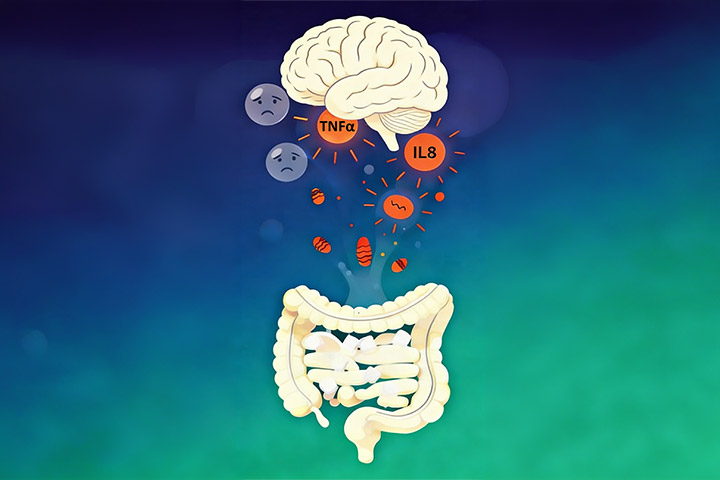
Fructose malabsorption induces dysbiosis and increases anxiety
In collaboration with researchers from the MICALIS laboratories (Paris-Saclay University, INRAE) and Rouen University Hospital, a study conducted by researchers from NutriNeuro (University of Bordeaux, INRAE, Bordeaux INP) highlights a new link between fructose malabsorption, gut microbiota, inflammation and emotions. Their findings have just been published in the journal Brain, Behaviour, and Immunity.
Excessive fructose intake is a growing public health concern, yet many individuals have a limited capacity to absorb typical dietary levels, leading to chronic fructose malabsorption and intestinal spillover. In animal models, this spillover disrupts the gut microbiota, but its impact in humans remains unexplored. We hypothesized that fructose malabsorption–induced dysbiosis contributes to peripheral inflammation, which, together with neuroinflammation, plays a role in mood disorders. This study investigates the link between fructose malabsorption, gut microbiota, and mood disorders in a human cohort, and explores their association with neuroinflammation in a GLUT5 knockout mouse model of fructose-malabsorption.
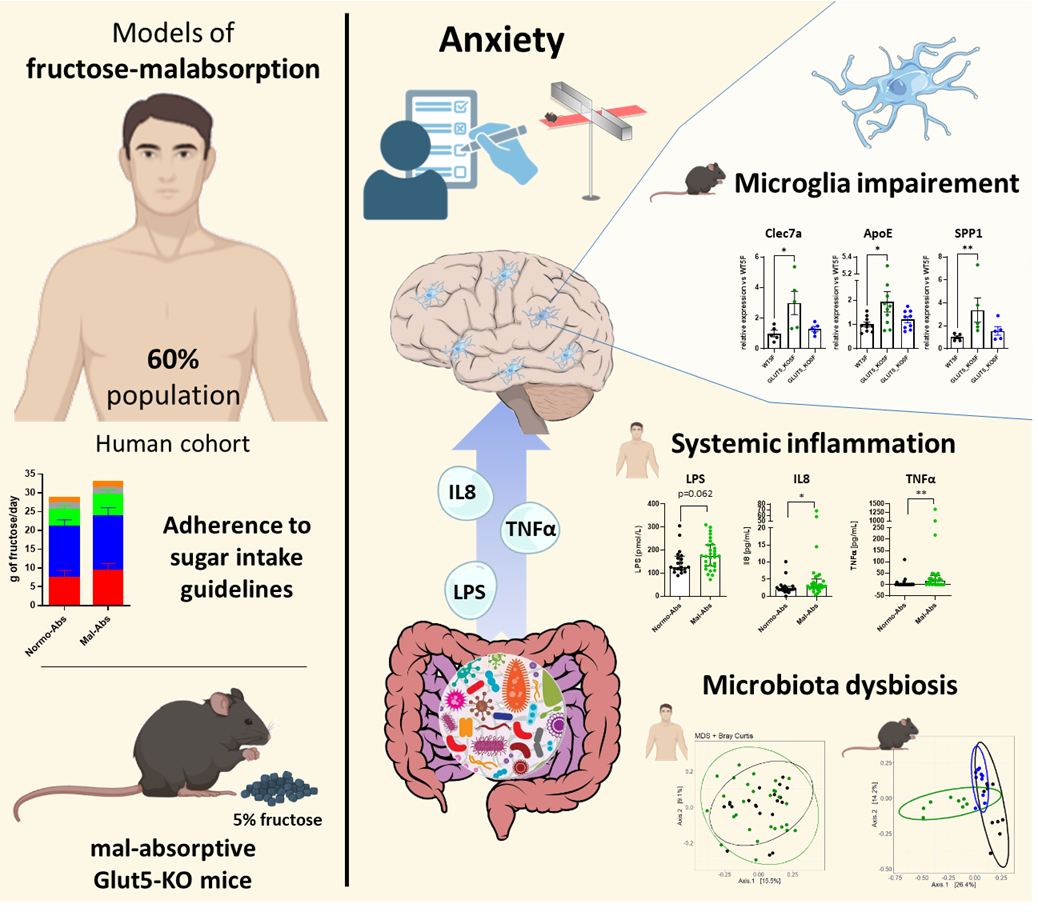 In a human cohort of male healthy volunteers, fructose malabsorption was assessed using a breath hydrogen test, while plasma lipopolysaccharide (LPS) levels and anxiety traits (measured using the State-Trait Anxiety Inventory, STAI) were analyzed. Gut microbiota composition was characterized through 16S rRNA sequencing, and dietary fructose intake was recorded. In the preclinical study, Glut5-KO male mice, which lack intestinal fructose transport, were fed a 5% fructose diet for four weeks. Behavioral assays assessed anxiety- and depressive-like behaviors, while gut microbiota composition and microglia-associated gene expression were analyzed.
Sixty percents of volunteers exhibited fructose malabsorption, along with elevated plasma LPS levels, increased anxiety traits on the STAI, and distinct gut microbiota alterations, partially linked to fructose intake patterns. The average daily fructose intake was 30 g per individual, with significant variability in dietary sources. In the preclinical model, Glut5-KO mice on a 5% fructose diet displayed increased anxiety- and depressive-like behaviors, pronounced gut microbiota shifts, and altered expression of microglia-associated genes.
These findings highlight the complex interplay between dietary fructose, gut microbiota, and neuroinflammation in shaping mental health. Chronic fructose malabsorption may contribute to mood disorders through gut dysbiosis and microglia-dependent neuroinflammation, warranting further investigation into dietary interventions.Article
Fructose malabsorption induces dysbiosis and increases anxiety in male human and animal models
Adeline Coursan1, Delphine Polve1,2, Anne-Marie Leroi3,4,5, Magali Monnoye2, Lea Roussin2, Clara Benatar2, Marie-Pierre Tavolacci3,4, Muriel Quillard Muraine3,4,6, Mathilde Maccarone7, Olivia Guérin8, Estelle Houivet8, Charlène Guérin3, Valery Brunel6, Jérôme Bellenger9, Jean-Paul Pais de Barros9,10, Guillaume Gourcerol3,4,5, Laurent Naudon2, Sophie Layé1, Charlotte Madore1, Xavier Fioramonti1,*#, Chloé Melchior3,4,7,*, Véronique Douard2,*#
1Univ. Bordeaux, INRAE, Bordeaux INP, NutriNeuro, UMR 1286, F-33000 Bordeaux, France.
2Université Paris-Saclay, INRAE, AgroParisTech, MICALIS Institute, Jouy-en-Josas, France.
3 Univ Rouen Normandie, INSERM, ADEN UMR1073, Nutrition, Inflammation and microbiota-gut-brain axis.
4CHU Rouen, CIC-CRB 1404, F-76000 Rouen, France.
5CHU Rouen, Physiology Department, F-76000 Rouen, France.
6CHU Rouen, department of General Biochemistry, F-76000 Rouen, France
7CHU Rouen, Department of Gastroenterology, F-76000 Rouen, France
8CHU Rouen department of Biostatistics, F-76000 Rouen, France.
9LipSTIC LabEx, FCS Bourgogne-Franche Comté, Dijon, France.
10 Plateforme DiviOmics, UMS BioSanD 58, Université de Bourgogne, F-21000 Dijon, France.
*: These authors equally contributed to this work
# : Corresponding authors
DOI : 10.1016/j.bbi.2025.106221
Last update 23/02/26