
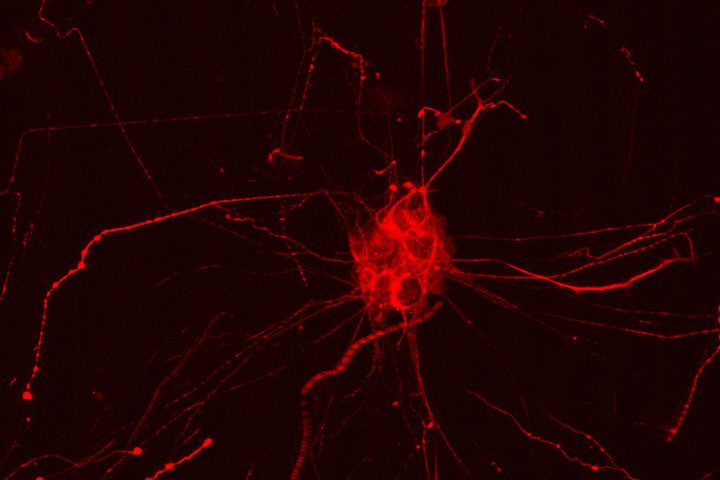
PLCG2 downregulation impairs synaptic function and increases Alzheimer’s disease hallmarks in neuronal cultures
Christophe Mulle (IINS) is a co-senior author of a collaborative study carried out with a team of researchers from Lille and several international partners, published in Nature Genetics. Avishek Roy, who was a post-doctoral researcher in Carta-Mulle’s team from 2022 to 2024, is one of the first authors.
Their discovery sheds light on the role of the PLCG2 gene in the mechanisms underlying Alzheimer’s disease. PLCG2, a gene already known to be associated with the risk of developing the disease, plays a key role in synaptic function that had not previously been suspected. Another significant finding is that rare variants of this gene can increase the risk of developing Alzheimer’s disease tenfold.
Read the Inserm press release (in french)
Abstract
We developed a high-content screening to investigate how Alzheimer’s disease (AD) genetic risk factors may affect synaptic mechanisms in rat primary neuronal cultures. Of the target genes identified, we found that Plcg2 downregulation in mouse dentate gyrus neurons consistently disrupted dendritic morphology and synaptic function. In human neuronal cultures (hNCs), PLCG2 downregulation also impaired synaptic function and increased amyloid-β (Aβ) levels and Tau phosphorylation. Very rare PLCG2 loss-of-function (LoF) variants were associated with a tenfold increased AD risk. PLCG2 LoF carriers show low mRNA/protein PLCG2/PLCγ2 levels and the R953* LoF mutation compromised synaptic function and increased AD hallmarks in hNCs. Single-nucleus RNA sequencing analyses confirmed that the downregulation of PLCG2 impacted pathways related to synaptic and neuronal functions, potentially through neurexins in neurons. In conclusion, PLCγ2 downregulation could increase AD risk by impairing synaptic functions and by increasing Aβ levels and Tau phosphorylation in neurons.
Reference
PLCG2 downregulation impairs synaptic function and increases Alzheimer’s disease hallmarks in neuronal cultures
Coulon A, Rabiller F, Takalo M, Roy A, Pelletier A, Martiskainen H, Siedlecki-Wullich D, Lannette-Weimann N, Majerníková N, Grenon A, Gao V, Erhardt A, Pernodet A, Lemaire M, Limoge F, Walle P, Mendes T, Guyot K, Lemeu C, Carvalho LI, Melo de Farias AR, Hulsman M, Najdek C, Freire-Regatillo A, Saha O, Amouyel P, Charbonnier C, Deleuze JF, Dols-Icardo O, Jeskanen H, Willman RM, Kuulasmaa T, Kurki M, Hardy J, Heikkinen S, Holstege H, Mäkinen P, Nicolas G, Mead S, Wagner M, Ramirez A, Rauramaa T, Palotie A, Sims R, Soininen H, van Swieten J, Williams J, Bellenguez C, Gelle C, Lambert E, Costa MR, Tcw J, Glaab E, Ayral AM, Demiautte F, Grenier-Boley B, Muntaner M, Eberlé D, Deforges S, Haas JT, Kilinc D, Mulle C, Chapuis J, Hiltunen M, Dumont J, Lambert JC.
Nat Genet. 2026 Aug 14.
DOI: 10.1038/s41588-026-02709-5
Last update 26/08/26