
Why can gentle touch be harder to perceive in autism?
Andreas Frick’s team, from Neurocentre Magendie, has published a new article in Advanced Science.
Comment
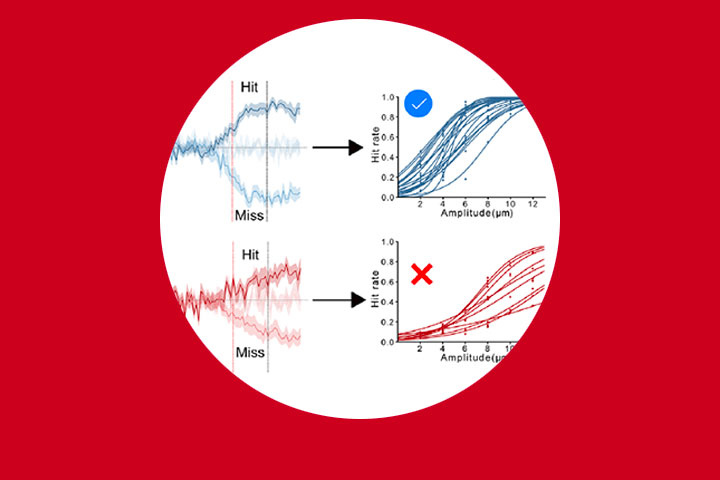
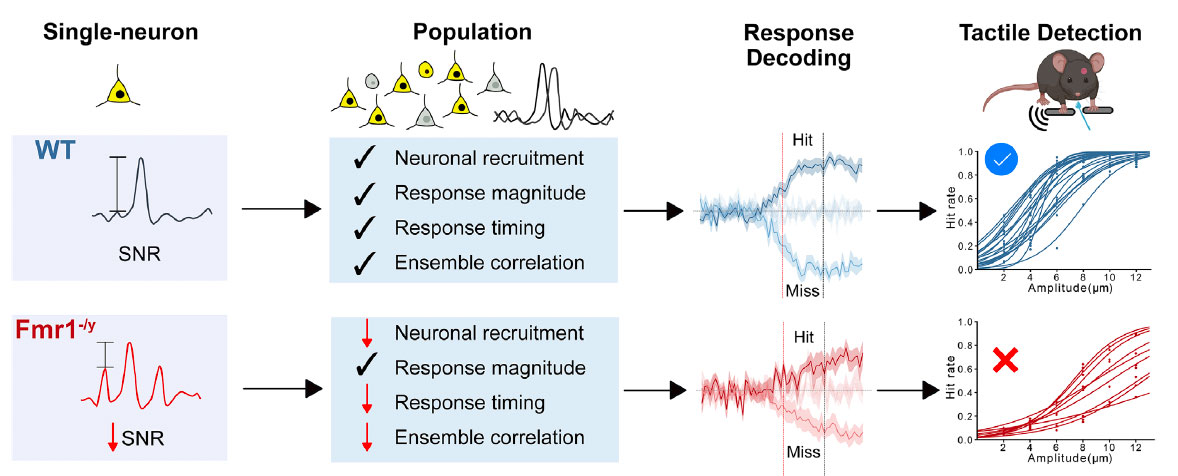
Our study offers a new step toward understanding tactile hyposensitivity in autism. Using a translational perceptual task in Fmr1−/y mice, we found impaired detection of faint tactile stimuli in a subgroup of animals. This hyposensitivity was associated with a reduced cortical signal-to-noise ratio, weaker sensory encoding, and disrupted ensemble dynamics in the primary somatosensory cortex. Strikingly, lowering neuronal excitability improves both encoding and tactile perception. This work provides a translational framework for probing neuronal-perceptual changes in neurodevelopmental conditions, reveals inter-individual variability in preclinical models, and uncovers the neural basis of tactile hyposensitivity in autism.
Reference
Diminished Signal‐to‐Noise Ratio Disrupts Somatosensory Population Encoding and Drives Tactile Hyposensitivity in the Fmr1−/y Autism Model
Ourania Semelidou, Théo Gauvrit, Célien Vandromme, Alexandre Cornier, Anna Saint‐Jean, Yves Le Feuvre, Melanie Ginger, Andreas Frick
Advanced Science. 2026-04-15
10.1002/advs.202519479
Last update 07/05/26