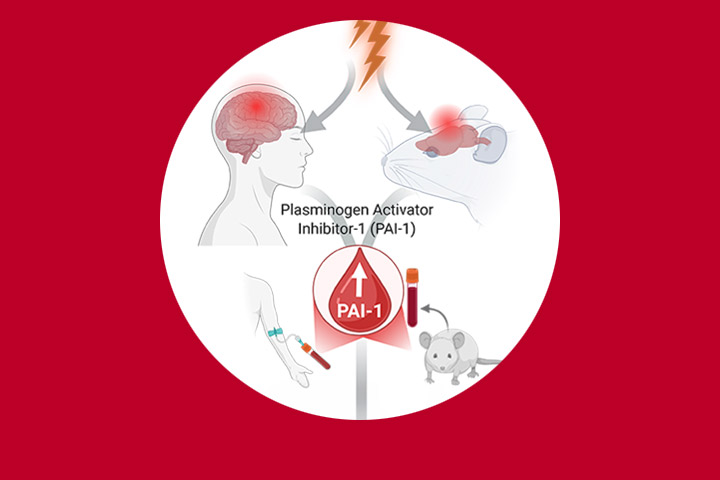
Stress-induced plasminogen activator inhibitor-1 (PAI-1) as a blood biomarker and brain risk factor for PTSD.
Jean-Michel Revest’s team, from Neurocentre Magendie, in collaboration with Aline Desmedt’s teams and clinicians from the French Armed Forces Biomedical Research Institute (IRBA), has published a translational study in *Molecular Psychiatry* identifying the stress-induced type-1 plasminogen activator inhibitor (PAI-1) as a blood biomarker and cerebral risk factor for Post-Traumatic Stress Disorder (PTSD).
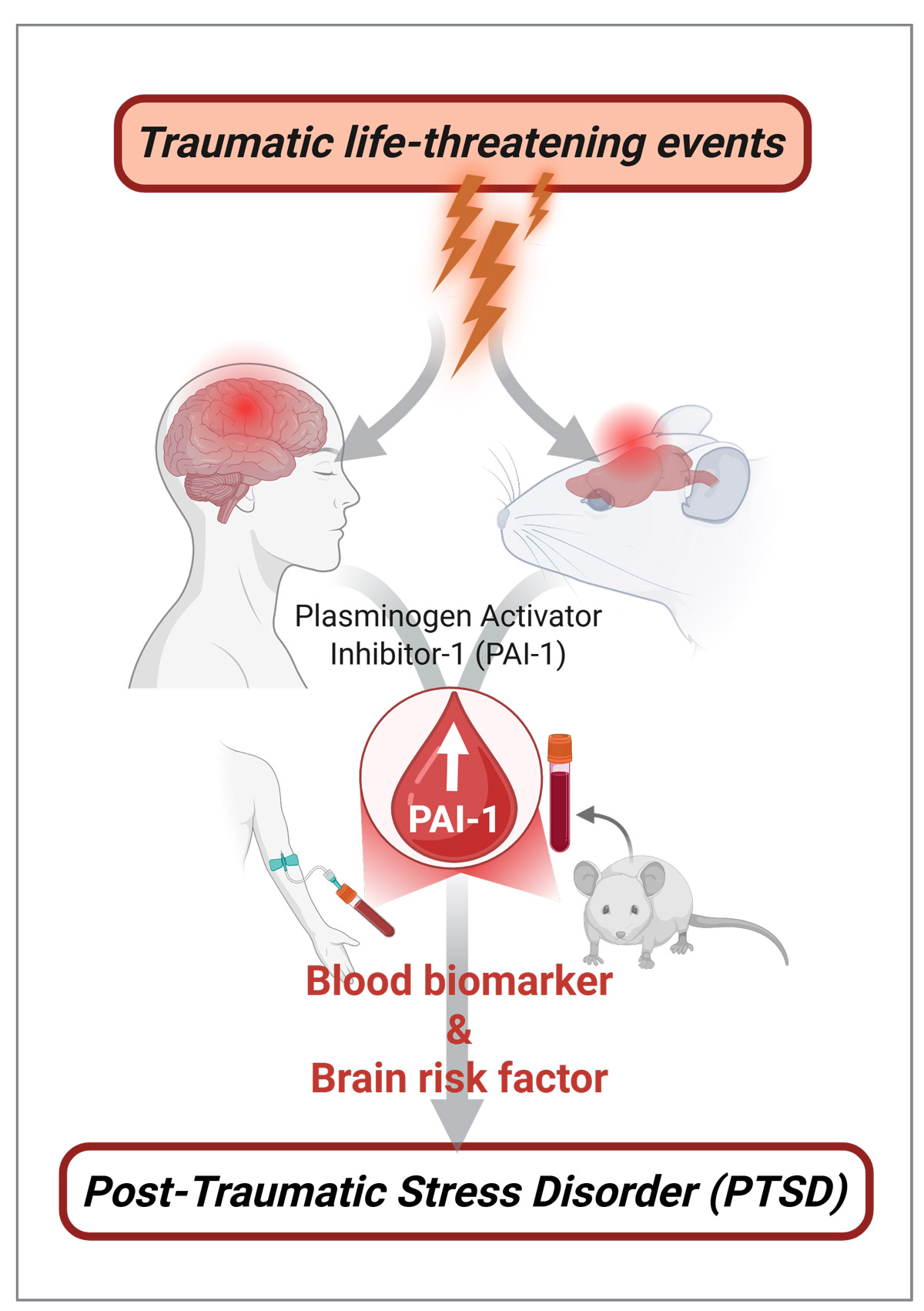 Post-traumatic stress disorder (PTSD) is a severe stress-related psychiatric condition triggered by traumatic life-threatening events, characterized notably by an altered memory profile. Although clinically well-documented, no specific biomarker exists. This translational study identifies plasminogen activator inhibitor-1 (PAI-1) as a brain risk factor for PTSD, thereby supporting its potential as a blood-derived biomarker. Mice with genetically ablated PAI-1 were protected from developing a PTSD-like memory profile. Conversely, mice exhibiting PTSD-like cognitive impairment showed increased blood PAI-1 levels, correlating with their profile severity. In the brain, PAI-1 levels were specifically increased in the dorsal hippocampus, a key region for cognitive functions and in the etiology of PTSD. Finally, a longitudinal study of soldiers revealed that those developing PTSD symptoms exhibit rising blood PAI-1 levels over a 12-month period. Its significant association with various indicators of PTSD-related psychological distress attests to PAI-1’s potential as a blood biomarker and brain therapeutic target for PTSD.
Reference
Stress-induced plasminogen activator inhibitor-1 (PAI-1) as a blood biomarker and brain risk factor for PTSD.
Mol Psychiatry (2026).
https://doi.org/10.1038/s41380-026-03564-w
1 Univ. Bordeaux, Inserm, Neurocentre Magendie, U1215, F-33000, Bordeaux, France. .
2 Univ. Bordeaux, Inserm, Neurocentre Magendie, U1215, F-33000, Bordeaux, France.
3 Institut de Génomique Fonctionnelle (IGF), Univ. Montpellier CNRS, Inserm, 34094, Montpellier, France.
4 Institut for Neurosciences of Montpellier (INM), Univ. Montpellier, CNRS, Inserm, 34000, Montpellier, France.
5 Unité de Neurophysiologie du Stress, Département Neurosciences & Contraintes Opérationnelles, Institut de Recherche Biomédicale des Armées (IRBA), 91223, Brétigny-sur-Orge, France.
6 French Society for Traumatic Stress Studies (FSTSS), 44600, Saint-Nazaire, France.
7 École de Psychologues Praticiens (EPP), 23 rue du Montparnasse, 75006, Paris, France.
8 Univ. Lorraine, Inserm, INSPIIRE, UMR 1319, F-54000, Nancy, France.
9 Univ. Bordeaux, Inserm, Neurocentre Magendie, U1215, F-33000, Bordeaux, France. .
10 French Society for Traumatic Stress Studies (FSTSS), 44600, Saint-Nazaire, France. .
Last update 03/04/26