
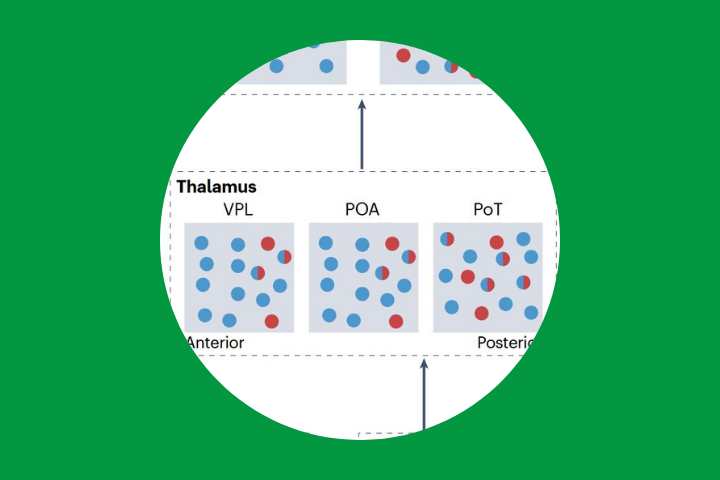
Mario Carta et al. in Nature reviews neuroscience
Mario Carta (IINS), alongside Mikkel Vestergaard (University of Copenhagen) and James. F. A Poulet (MDC and Neuroscience research center, Berlin), published a study on thermosensation.
How does the brain encode thermal information?
At every moment of our lives, we are immersed in an environment where temperature constantly fluctuates. The warmth of the sun on our skin, the touch of a cool object, or the refreshment of a cold drink continually stimulate our brain, which reads and interprets thermal information from the world around us. Temperature is a fundamental element of our experience and how we interact with our environment. For all animals, it plays a crucial role in shaping behaviors, selecting habitats, and surviving changing conditions.
Yet, despite its importance, our understanding of how the brain detects and perceives temperature remains limited compared to other senses like vision or hearing. Most research and reviews on thermosensation have focused on extreme, painful temperatures—those that burn or freeze the skin—as well as the molecular sensors that detect them, such as TRP ion channels. Far less attention has been paid to the perception of non-painful temperature variations, which are essential for guiding behaviors.
In our review, we highlight the neural circuits and cellular mechanisms that enable animals — including rodents, primates (including humans), and insects — to detect and interpret non-painful sensations of warmth and coolness. We examine how these thermal signals are transmitted from the periphery to the brain, and how distinct patterns of neural activity give rise to the complex sensations associated with temperature. By comparing mammals and insects, we reveal striking similarities, as well as important differences, in how their nervous systems encode and respond to temperature, uncovering principles of thermosensation conserved throughout evolution.
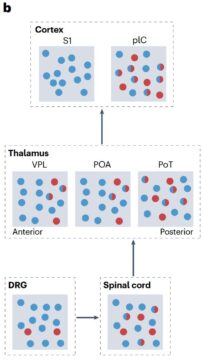
Figure legend:
Thermal cellular tuning varies across different stages of the perceptual pathway. In the dorsal root ganglion (DRG), many neurons are excited by cool (blue circles) while very few are excited by non-painful warm (red circles). This changes in the spinal cord, where there are more warm-excited and broadly tuned neurons excited by both warm and cool (blue and red circles). In the thalamus, more warm tuning is observed in posterior regions of the ventral posterolateral nucleus (VPL) and the posterior nucleus (PO) as well as in the posterior triangular nucleus (PoT), whereas more anterior regions of the VPL and PO show cool tuning. In the cortex, the primary somatosensory cortex (S1) is mostly cooltuned, whereas the posterior insular cortex (pIC) contains warm, cool and warm− cool neurons (DRG, spinal cord, thalamus, cortex). Arrows show the direction of thermal information flow.
Reference
Mario Carta 1#, Mikkel Vestergaard 2# & James. F. A Poulet 3,4#
The neuronal circuits and cellular encoding of thermosensation.
1 Institut Interdisciplinaire de Neurosciences, CNRS UMR 5297, Université de Bordeaux, Bordeaux 33000, France
2 Department of Neuroscience, Faculty of Health and Medical Sciences, University of Copenhagen, Copenhagen, Denmark.
3 Max Delbrück Center for Molecular Medicine in the Helmholtz Association (MDC), Berlin, Germany.
4 Neuroscience Research Center, Charité-Universitätsmedizin Berlin, Berlin, Germany.
# : Corresponding authors
DOI: 10.1038/s41583-025-01001-5
Last update 02/03/26